
How to Run KYC Checks on Marketplace Sellers
Learn when to verify marketplace sellers, how KYC checks work, and how Zoneless manages risk flags, verification rules, and payouts.

Marketplace KYC is the process of confirming a seller's identity before allowing them to receive payouts. A practical KYC policy collects basic details during onboarding, looks for suspicious patterns, and asks for an identity document and selfie when a seller reaches a risk or payout threshold.
This helps stop fake accounts, repeat abusers, and people using stolen details. It also gives your team something concrete to review when an account does not look right.
A safer marketplace is also easier to grow. Good sellers are more likely to stay when they trust the platform, and buyers are more likely to return when spam and scams are dealt with quickly. KYC helps protect that trust as your marketplace gets bigger.
Why marketplaces run KYC
Most sellers are genuine. A small number will try to open several accounts, abuse promotions, move stolen money, or return after being banned.
KYC makes this harder by connecting an account to a real identity. It can also help you:
- Find several accounts using the same personal details
- Review sellers before they receive larger payouts
- Keep a record of why a payout was allowed or blocked
- Meet identity requirements that apply to your marketplace
KYC does not prove that someone is trustworthy, and it does not stop every kind of fraud. It works best alongside account monitoring, payout limits, manual reviews, and clear marketplace rules.
When should you verify a seller?
You can ask every seller to complete KYC before their first payout. This gives you the most certainty, but it also adds friction for new sellers who may never make a sale.
Another option is to verify sellers when they reach a payout threshold. For example, you could let a seller receive up to $30, then require KYC before allowing any more payouts. This keeps early onboarding simple while adding stronger checks as the amount at risk grows.
You may also want to start KYC when:
- The same details appear across several accounts
- Account details change shortly before a payout
- Your team manually flags the account
- Your own data shows a higher risk for a particular type of account
One unusual detail is not proof of fraud. Someone may live abroad or keep a phone number from their home country. Treat risk signals as a reason to review or verify an account, not as an automatic reason to reject it.
What happens during a KYC check?
A normal marketplace KYC flow has five steps:
- The seller enters basic personal details during onboarding.
- Your marketplace decides that identity verification is required.
- The seller uploads an identity document and takes a selfie.
- A verification provider checks the document and compares it with the seller.
- Your marketplace allows, pauses, or blocks payouts based on the result.
Keep payouts paused while a check is pending or needs manual review. A seller reaching the final page does not mean they passed.
You should also plan for checks that expire or are reopened later. A seller who passed once may need to provide a new document in the future.
How Zoneless handles seller verification
Zoneless runs lightweight checks when each connected account is created. It can flag signals such as repeated personal details or a mismatch between the seller's phone number and home country. You can review the reason from your platform dashboard.
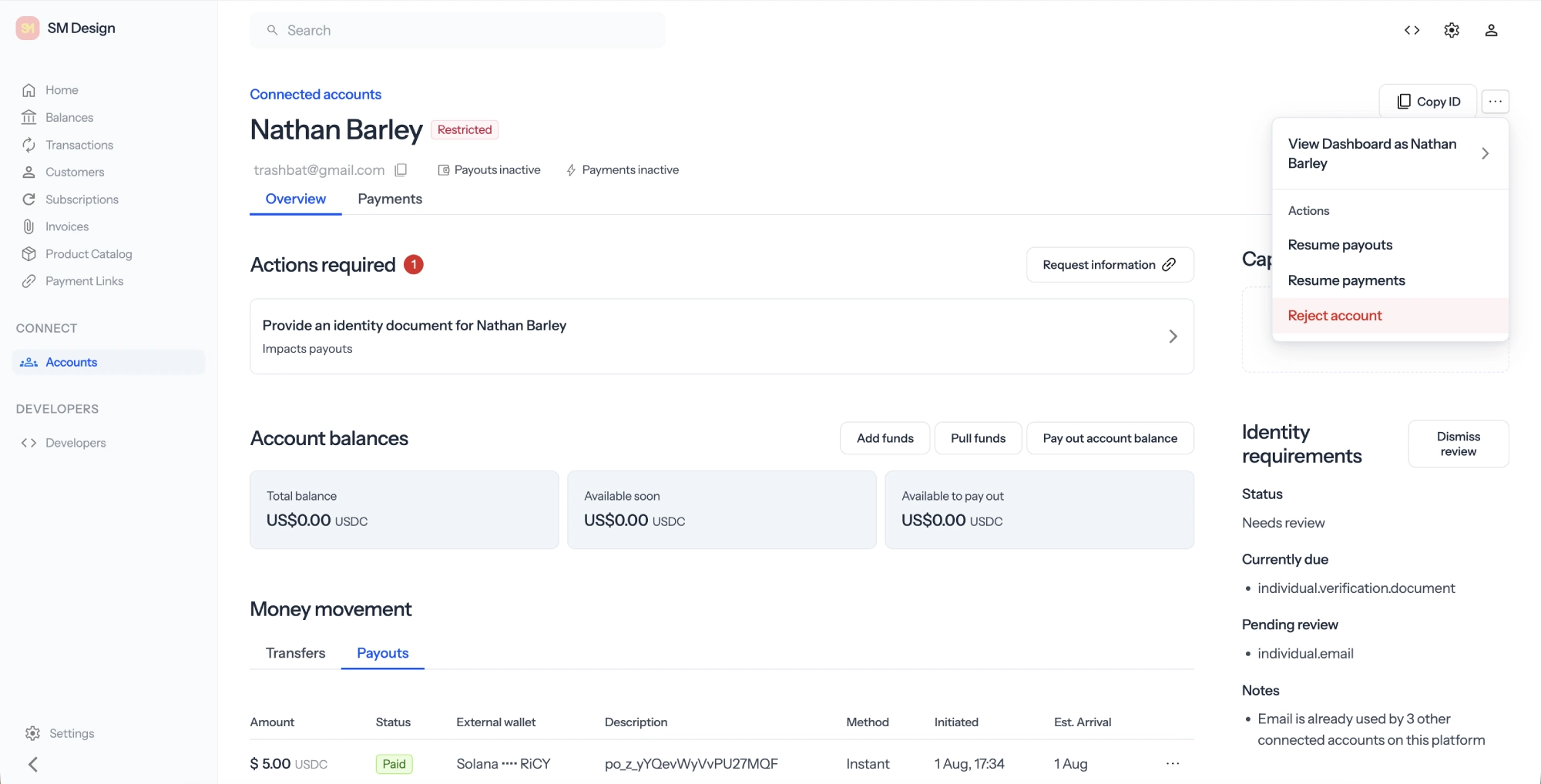
For full KYC, Zoneless seamlessly integrates with Didit. Didit hosts the document and selfie flow, verifies the document, checks that the selfie is of a real person, and compares the two. This means you do not need to build your own document upload flow.
Didit currently includes 500 full KYC checks each month for free. Additional checks cost $0.33 each. To connect it, create an API key in Didit and simply paste it into your Zoneless settings.
Set rules that fit your marketplace
Zoneless lets you choose the payout volume at which KYC becomes required. You can also set different thresholds by country. If your own data shows a high rate of suspicious accounts from a particular country, you could require sellers there to verify before their first payout.
I ran into this problem on PromptBase. What appeared to be one person or group kept creating accounts from Pakistan with similar names and email addresses. They flooded our review system with spammy submissions and brought down the overall quality of the marketplace.
Stripe Connect's onboarding did not seem to stop them, and I could not set a rule for this specific pattern. With Zoneless, I can set rules to require sellers from Pakistan to complete an identity and selfie check before receiving payouts. Genuine sellers can still join, but it becomes much harder for one person to run lots of paid seller accounts.
Base these rules on evidence and review them regularly. A country alone is not proof that someone is acting dishonestly.
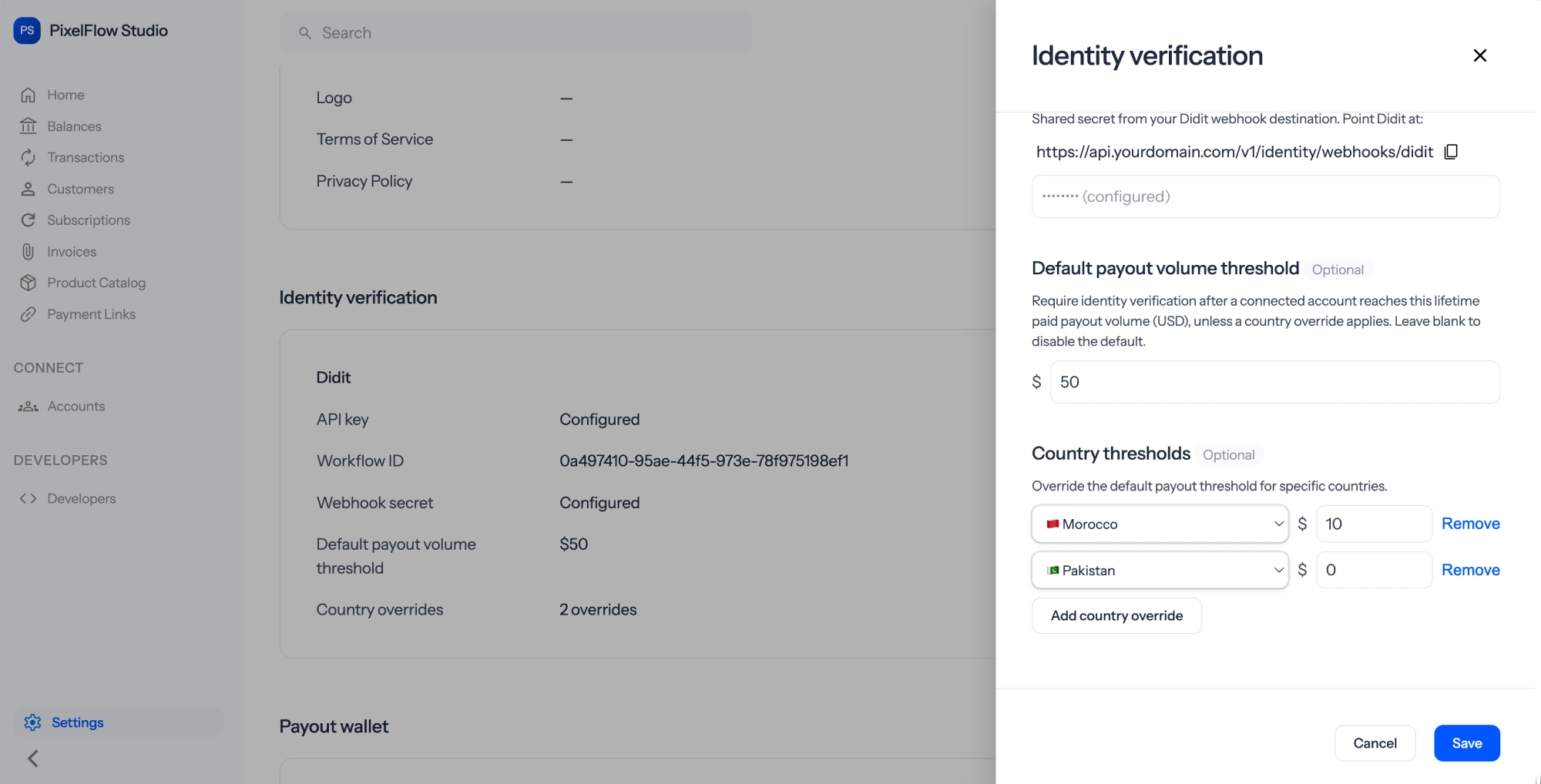
When a seller needs to complete a check, Zoneless notifies them and guides them through the process. Your team can track pending, passed, and failed checks from the platform dashboard.
Your application can also listen for verification updates through webhooks. The pattern works like Stripe: register an endpoint, choose the events you need, and update your records when an account needs verification or completes a check.
The identity verification setup guide covers connecting your provider, setting your rules, and handling verification updates.
Marketplace KYC questions
Does every marketplace seller need KYC?
Not necessarily. Some marketplaces verify every seller before their first payout. Others use payout limits and risk signals to decide when a check is needed. The legal requirements depend on your business and where it operates.
What does a seller need for KYC?
A typical check asks for a government-issued identity document and a selfie. The provider checks whether the document appears valid and whether the person taking the selfie matches its photo.
Can a seller receive payouts before completing KYC?
That depends on your policy. You might allow small payouts before verification, then pause further payouts when the seller reaches a limit. Higher-risk marketplaces may require verification before the first payout.
How much does seller KYC cost?
The price depends on your provider. Didit currently gives each workspace 500 full KYC checks per month for free, then charges $0.33 for each additional check.
Make safety part of your payout flow
KYC is only one part of marketplace safety, but it makes repeat abuse harder and gives your team better information when something looks wrong.
Zoneless brings risk checks, verification rules, seller notifications, and payout controls into the same open-source system you use to onboard and pay sellers. You keep control of the policy and your payout stack, while sellers can receive USDC anywhere with near-zero network fees.